💿 Discography

📖 Biography
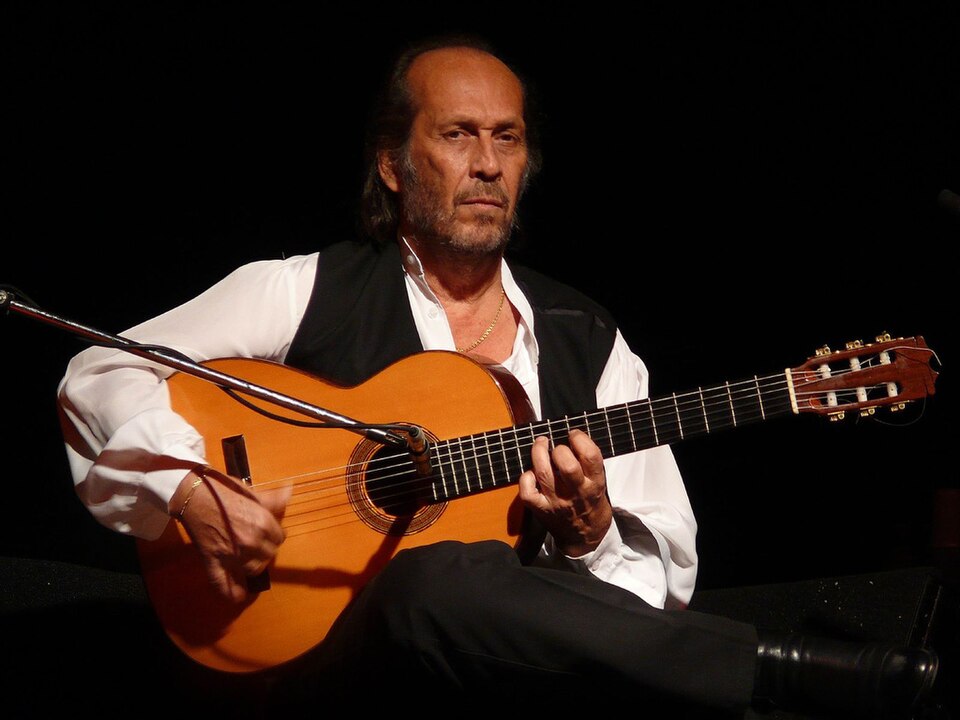
On February 25, 2014, in a hospital in Playa del Carmen, a heart attack silenced the fingers that had rewritten the rules of the guitar. Paco de Lucía did not die that day: he became a legend. But what hurts is not his absence, but the silence he left behind. Because no one—before or after—has managed to make six nylon strings sound like a choir of angels and demons at the same time, with that mix of surgical precision and gypsy fire that only he mastered.
Francisco Sánchez Gómez was born in 1947 in Algeciras, in the La Bajadilla neighborhood, where the smell of saltpeter mingled with that of taverns where his father, Antonio Sánchez, played bulerías. Young Paco—so they called him to distinguish him from his older brother, also Francisco—learned to strum before he could read. At seven he was already accompanying his father at private parties; at twelve he recorded his first album. But what really marked him was something that does not appear in any official biography: the obsession with breaking limits. "I didn't want to be the best flamenco guitarist," he once confessed. "I wanted to be the best guitarist, period."
The technique that challenged physicsThere is a moment in Friday Night in San Francisco (1981) that defines his genius. John McLaughlin and Al Di Meola—two titans of electric guitar—wait for their turn on the Warfield Theatre stage. When Paco starts playing Mediterranean Sundance, the two look at each other: it is impossible for those fingers to move so fast without losing the beat. The recording, turned gold record halfway around the world, captured more than virtuosity: it proved that flamenco could be fused with jazz without losing its soul. "Paco didn't play the guitar," Di Meola said years later. "He made it cry, laugh, and scream at the same time."
His technique was a controlled heresy. While other flamenco guitarists clung to tradition, he incorporated classical guitar picado, jazz phrasing, and even the Peruvian cajón (which he popularized in Spain). But the most revolutionary thing was not what he added, but what he removed: fear. In Almoraima (1976), for example, he stripped flamenco of its rigidity to create a sound that sounded like freedom. "Flamenco is not a museum," he said. "It is a living being, and living beings change."
The duo that changed flamenco foreverIf Paco de Lucía was the architect of modern flamenco, Camarón de la Isla was his voice. Together they recorded albums that are now bibles: Canastera (1972), Soy caminante (1974), Castillo de arena (1977). Each was a battle between the purity of cante jondo and innovation. Camarón, with that throat that seemed to come from a goblin, and Paco, with his falsettos that sounded like pure poetry. "When we played together," Camarón recalled, "it was as if time stopped. There was no audience, no stage. Just us and the music."
Their collaboration was not easy. Paco, a perfectionist to the point of exasperation, demanded endless rehearsals; Camarón, free as the wind, arrived late or didn't show up. But when they fit together, the result was magical. In La leyenda del tiempo (1979), their most ambitious work, they mixed flamenco with rock, jazz, and even Lorca lyrics. Flamenco purists branded them traitors; the world hailed them as visionaries. Today, that album is considered the Sgt. Pepper’s of flamenco.
The legacy no one has matchedPaco de Lucía left more than 30 albums, but his true legacy is not in the numbers. It is in that way of playing that made even the uninitiated feel flamenco in their guts. It is in the cajón, which he turned into a flamenco instrument. It is in guitarists like Tomatito, Vicente Amigo, or Niño Josele, who grew up listening to his albums as if they were evangelists. And above all, it is in that idea that tradition is not a corset, but a springboard.
He died in Mexico, far from his native Algeciras, but his music continues to sound in unexpected places: from the tablaos of Seville to the conservatories of New York. In 2023, Rolling Stone included him in its list of the 200 greatest guitarists of all time, alongside Hendrix and B.B. King. But he, who always fled awards, would have preferred to be remembered for something simpler: for having made flamenco guitar sound as if it had been waiting centuries for someone to truly understand it.
Today, when you listen to Entre dos aguas—that track he composed in half an hour and that became an anthem—there is something that hurts: the certainty that no one will play like that again. It is not nostalgia. It is the realization that genius, sometimes, only passes once.