💿 Discography

📖 Biography
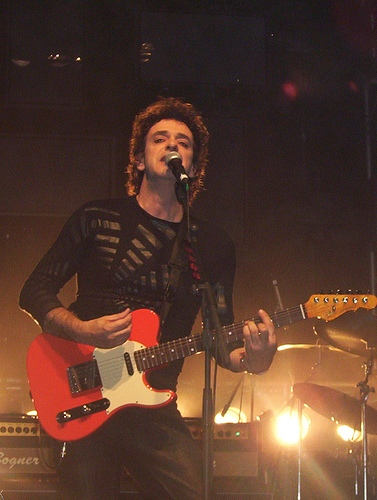
On May 15, 2010, Gustavo Cerati took the stage at Luna Park in Buenos Aires. It was the last night of his *Fuerza Natural* tour, and although nobody knew it then, it would be his final concert. Three days later, a stroke left him in a coma. Four years later, Spanish‑language rock lost its boldest architect. But what remained—the catalog of songs that continue to play in stadiums, bars, and headphones—is much more than a legacy: it is proof that the language could sound as sophisticated, visceral, and universal as the best Anglo‑Saxon rock.
Born in Barracas in 1959, Cerati grew up listening to The Beatles and Pink Floyd, but also to the tango musicians of the old guard. That mix—global and local, pop and experimental—would become the hallmark of Soda Stereo, the band he formed in 1982 with Zeta Bosio and Charly Alberti. They were not the first to sing rock in Spanish, but they were the first to do it with the ambition of a *Pet Sounds* or a *The Dark Side of the Moon*.
Soda Stereo: when Spanish‑language rock stopped being a minor genreBefore Soda, Spanish‑language rock was, at best, a curiosity. Bands like Los Saicos or Los Gatos had paved the way, but the genre was still seen as something minor, almost folkloric. Cerati and company came to shatter that idea. With *Signos* (1986) and *Doble Vida* (1988), the band proved that Spanish‑language rock could have the same lyrical depth, the same impeccable production, and the same ability to connect with the masses as its Anglo‑Saxon counterparts.
What set Soda apart was not just the music, but the attitude. Cerati played guitar as if each note were a whip: precise, yet with a hint of controlled chaos. His lyrics, on the other hand, were something else entirely. They did not talk about teenage love or political slogans, but about dreams, cities that fade, loves that dissipate like smoke. Songs like *Persiana Americana* or *De Música Ligera* are not anthems by accident: they are perfect pieces, with hooks that lodge in memory like hooks.
But the real leap came with *Canción Animal* (1990). Produced by Gustavo Santaolalla, the album is a masterpiece of textures: guitars that sound like futuristic machines, basses that throb like earthquakes, voices that shift from whisper to shout in a second. *Un millón de años luz* or *Té para tres* are not songs; they are auditory experiences. And the most impressive thing is that, despite its complexity, the album sold half a million copies in Latin America. That had not happened since the days of *Thriller*.
Reinvention: when Cerati went soloIn 1997, Soda Stereo announced its split. Many thought Cerati would stay within the mold of what he had already done. They were wrong. His first solo album, *Bocanada* (1999), was an earthquake. Recorded in London with musicians from the British electronic scene, the album sounded as if the future had arrived early. Songs like *Puente* or *Paseo Inmoral* mixed programmed beats with distorted guitars, introspective lyrics, and an atmosphere that oscillated between dreamlike and claustrophobic.
Not everyone understood it. Some Soda fans accused him of betraying rock, of becoming "too weird." But Cerati was not there to please anyone. *Siempre es hoy* (2002) went deeper in that direction: sound collages, samples, processed voices. It was music to listen to with headphones, alone, as if each song were an intimate diary. Yet it was also music to fill stadiums. Because, in the end, what Cerati always had was that unique ability to sound both personal and massive.
His last studio album, *Fuerza Natural* (2009), was a return to guitars, but with the wisdom of someone who had already explored every corner of sound. Songs like *Cactus* or *Rapto* sounded fresh, urgent, as if time had not passed. And perhaps that is why his absence hurts so much: because just when it seemed Cerati had found a new way to reinvent himself, silence took him away.
The myth that keeps growingSome artists die and their legend freezes. Cerati does not. Every year that passes, his figure seems larger. Today, bands like Babasónicos, Miranda! or even trap artists like Trueno cite Soda Stereo as an influence. His songs play in movies, series, and commercials. But beyond that, what endures is the feeling that Cerati achieved something almost impossible: making Spanish‑language rock sound *important*.
It is not exaggerated to say that, alongside Luis Alberto Spinetta, he is the most influential musician in Argentine history. But even that comparison falls short. Spinetta was the poet, the visionary. Cerati was the architect: the guy who took loose ideas—a riff from The Cure, a sample from Kraftwerk, a tango melody—and turned them into something new, something that could only exist in Spanish.
And perhaps that is why his absence hurts so much. Because Cerati did not just leave songs: he left a manual on how to create art without limits. On how to break rules without losing elegance. On how to be popular without selling out. In a genre that sometimes seems doomed to repeat itself, he always sought the next step. And that, in the end, is what makes him eternal.
Today, when someone plays *Persiana Americana* at a party or *Crimen* on a sleepless night, Cerati is still there. Not as a ghost, but as something more powerful: as certainty. The certainty that, at some point, Spanish‑language rock had a genius. And that, against all odds, that genius was Argentine.