💿 Discography
📖 Biography
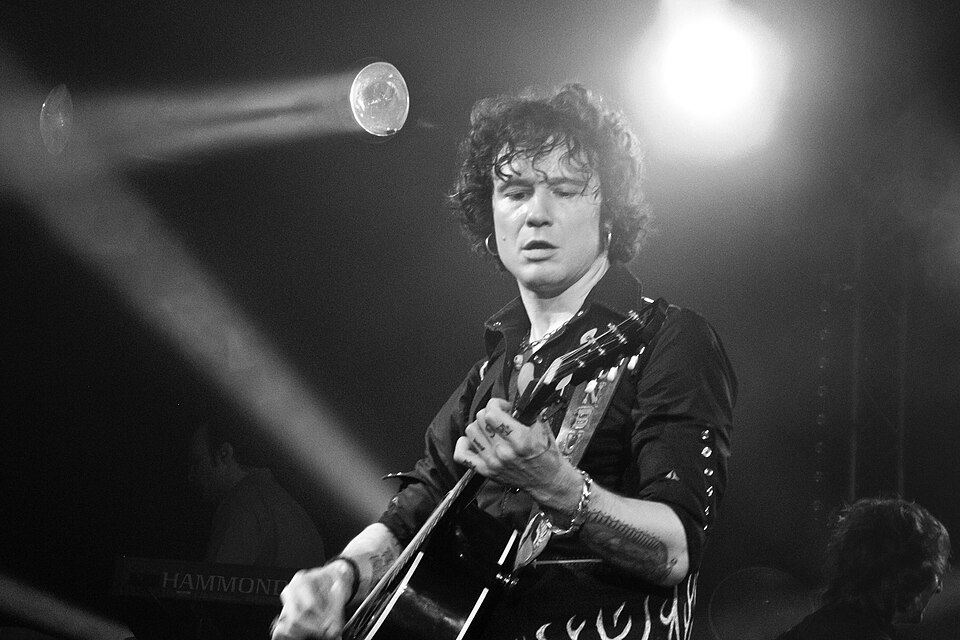
On August 11, 1996, in a sweltering Madrid, Enrique Bunbury took the stage at the Doctor Music festival wearing a black ripped‑sleeve shirt and a microphone that looked like an object stolen from another century. He had no backing band, only an acoustic guitar and a notebook of scribbled lyrics. That night, in front of 20,000 people waiting for the leader of Héroes del Silencio, he announced: "This is not a goodbye, it’s a see you later." And indeed it was. What followed—a whirlwind of records ranging from urban rock to bolero, from flamenco to electronica—did not only redefine his career, but proved that Spanish rock could be many things at once without losing its essence.
A native of Zaragoza born in 1967, Bunbury arrived when rock in Spain was still heard on smuggled vinyl and radio stations reluctantly programmed the Rolling Stones. His voice—this blend of guttural roar and seductive whisper—became famous with Héroes del Silencio, the band that in the ’90s crossed the Atlantic to show that Spanish rock was not a minor sub‑genre. But where others would have been content living off the hits of "Mar adentro" or "Entre dos tierras", Bunbury did what few artists dare: burn his own bridge. In 1996, at 29 and with the world at his feet, he dissolved the band and launched a solo career that now totals more than fifteen studio albums, each with a distinct personality.
A catalogue that sounds like several artists (but is just one)The fascinating thing about Bunbury is not only his ability to fill stadiums—from the Palacio de los Deportes in Madrid to the Auditorio Nacional in Mexico—but also how he has made each record sound as if it were recorded by another person. Radical Sonora (1997) is an electronic experiment with distorted guitars and lyrics that seem lifted from a cyber‑punk comic; El viaje a ninguna parte (2004) is a sonic western with violins and Leone‑style film atmospheres; Las consecuencias (2010) revives bolero and tango with an elegance that would make purists pale. And then there is El último de la fila (2020), an album that blends mariachi, rancheras and rock with a naturalness only he could afford without slipping into pastiche.
How does he do it? There is no formula, but there are clues. Bunbury has said in interviews that his creative process is "like cooking without a recipe": he takes ingredients from here and there—a 70s guitar riff, a cumbia rhythm, a stanza that recalls Lorca—and mixes them until it sounds new, yet recognizable. That said, three constants in his work never fail: his voice (that throat that jumps from whisper to shout in a second), his obsession with literature (his lyrics are full of references to Borges, Cortázar or Bukowski) and an attitude that borders on anarchic. "Rock is not a musical style, it’s an attitude," he has repeated to the point of exhaustion. And he certainly proves it.
The artist who won the battle against timeIn an industry where many artists repeat themselves until they become caricatures, Bunbury has spent three decades doing the opposite: reinventing himself without losing his essence. It’s not that he isn’t afraid of failure— in 2002, Flamingos divided critics and fans— but he embraces it as part of the game. "I’d rather make a mistake than do what’s expected of me," he told Rolling Stone in an interview. And that, in a genre as conservative as rock, is almost an act of rebellion.
His influence is hard to measure, but easy to feel. Artists like Vetusta Morla, Love of Lesbian or even Rosalía (in her early stages) have acknowledged their debt to him. But beyond the names, Bunbury has achieved something more important: showing that Spanish rock does not have to be a closed genre. It can embrace bolero, flamenco, electronica or mariachi without losing its soul. And that, in a world where music is often boxed into algorithmic playlists, is almost a miracle.
A few years ago, at a concert in Buenos Aires, someone in the audience shouted: "¡Bunbury, eres un puto genio!". He, unfazed, replied: "No, man. I’m just a guy who doesn’t know how to do anything else." The anecdote sums up his career: humble in form, relentless at heart. Because in the end, what Bunbury does is not just music. It’s proving that art, when made with honesty, has no expiration date.
And that, in these times of algorithms and fleeting trends, is almost an act of resistance.